Every business wants to know what is going to happen next. Will sales increase or decrease? Which customers are likely to leave? What products will people want next month? Which business decisions could create the best results?
While nobody can predict the future with complete accuracy, businesses can make much better predictions by using data. This is where predictive analytics comes into play.
Predictive analytics is a powerful approach that uses historical data, statistical techniques, machine learning, and other technologies to identify patterns and estimate what may happen in the future. Instead of relying only on assumptions or intuition, organizations can use available information to make more informed decisions.
Today, predictive analytics is being used across industries, including healthcare, finance, retail, marketing, manufacturing, transportation, and technology. As businesses continue to collect huge amounts of data, the importance of understanding and using that data is growing rapidly.
What Is Predictive Analytics?
Predictive analytics is the process of analyzing existing and historical data to make predictions about future events or outcomes.
For example, an online store can examine a customer’s previous purchases, browsing behavior, location, and interactions with the website. Based on these patterns, the company may predict which products the customer is most likely to purchase next.
Similarly, a bank can analyze financial behavior and credit history to estimate whether a customer is likely to repay a loan. A manufacturer can use information from machines to predict when equipment might fail.
The main idea is simple: past and present data can provide useful clues about the future.
Predictive analytics does not guarantee that a prediction will be correct. Instead, it gives organizations a probability or informed estimate that can support better decision-making.
How Does Predictive Analytics Work?
Predictive analytics usually involves several steps. The process begins with collecting relevant data from different sources.
This data may come from websites, mobile applications, customer records, sales systems, social media, sensors, financial transactions, or other digital platforms.
Once the data has been collected, it needs to be cleaned and organized. Poor-quality data can lead to inaccurate predictions, so removing errors, duplicates, and irrelevant information is an important part of the process.
The next step is to identify patterns and relationships within the data. Data analysts and data scientists may use statistical models and machine learning algorithms to understand how different factors are connected.
A predictive model is then created and tested using historical data. If the model performs well, it can be applied to new information to generate predictions.
For example, a retailer might build a model that predicts future product demand. When new sales information becomes available, the model can use it to estimate how much inventory the retailer may need.
Why Is Predictive Analytics Important?
One of the biggest advantages of predictive analytics is that it helps businesses move from reactive decision-making to proactive decision-making.
Without predictive analytics, a company may discover a problem only after it happens. With predictive models, the company can sometimes identify warning signs before the problem becomes serious.
For instance, if a business notices that certain customers regularly reduce their purchases before cancelling their accounts, it can use that pattern to identify customers who may be at risk of leaving.
The company can then take action, such as offering personalized support or a special promotion.
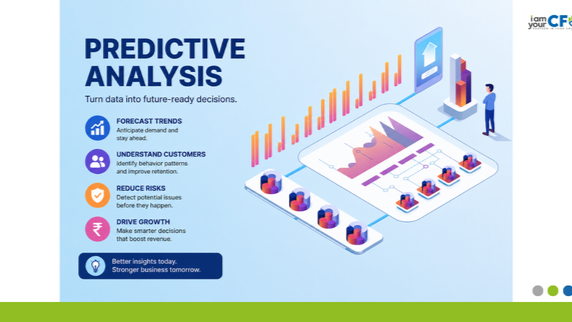
Predictive analytics can also help businesses reduce costs, improve customer experiences, manage risks, and identify new opportunities.
Common Uses of Predictive Analytics
Predictive analytics has a wide range of applications.
1. Sales Forecasting
Businesses can analyze previous sales, seasonal trends, customer demand, pricing, and market conditions to estimate future sales.
Accurate sales forecasts can help companies plan budgets, staffing, inventory, and marketing campaigns more effectively.
2. Customer Behavior Prediction
Companies want to understand what customers are likely to do next. Predictive analytics can help estimate whether a customer will make another purchase, cancel a subscription, respond to an advertisement, or interact with a particular product.
This information can make marketing more personalized and relevant.
3. Fraud Detection
Financial institutions and online businesses use predictive models to identify unusual transactions and potentially fraudulent activity.
For example, a system may recognize that a particular transaction differs significantly from a customer’s normal behavior. It can then flag the activity for additional review.
4. Predictive Maintenance
Manufacturing companies and other organizations often depend on expensive machinery. Unexpected equipment failures can result in significant downtime and repair costs.
Predictive analytics can analyze information from machines and sensors to identify signs that equipment may need maintenance.
Instead of waiting for a machine to break, a company can potentially repair it before a major failure occurs.
5. Healthcare
Predictive analytics can help healthcare organizations identify patterns in patient data and estimate potential risks.
For example, models may help healthcare professionals identify patients who could require additional monitoring. However, healthcare predictions need to be handled carefully because medical decisions involve privacy, accuracy, ethics, and professional judgment.
6. Inventory Management
Retailers need to maintain enough stock to meet customer demand without ordering excessive inventory.
Predictive analytics can estimate future demand based on previous sales, seasonal patterns, promotions, and other relevant factors. This can help businesses make smarter inventory decisions.
Predictive Analytics and Machine Learning
Predictive analytics and machine learning are closely connected, but they are not exactly the same thing.
Predictive analytics is a broader concept focused on using data to predict future outcomes. Machine learning is one of the technologies that can be used to create predictive models.
Machine learning algorithms can learn patterns from large datasets and improve their predictions as they receive more relevant information.
For example, an e-commerce company might use machine learning to analyze millions of customer interactions and recommend products that individual users are likely to buy.
Traditional statistical methods can also be used in predictive analytics. The appropriate approach depends on the type of data, business objective, and level of complexity involved.
Benefits of Predictive Analytics
There are several reasons organizations invest in predictive analytics.
Better decision-making: Businesses can use evidence and data instead of relying entirely on assumptions.
Improved customer experiences: Understanding customer behavior can help organizations provide more personalized products, services, and communication.
Reduced costs: Predicting equipment failures, demand, or operational problems can help companies avoid unnecessary expenses.
Risk management: Predictive models can identify potential risks before they become major problems.
Increased efficiency: Organizations can allocate employees, resources, inventory, and budgets more effectively.
Competitive advantage: Businesses that understand their data can often respond to changing customer needs faster than competitors.
Challenges of Predictive Analytics
Despite its advantages, predictive analytics is not perfect.
The quality of a prediction depends heavily on the quality of the data. If the data is incomplete, outdated, biased, or inaccurate, the resulting predictions may also be unreliable.
Another challenge is privacy. Businesses often work with sensitive customer information, so they need to handle data responsibly and follow applicable privacy and security requirements.
There is also the problem of bias. If historical data contains unfair or discriminatory patterns, a predictive model may learn and reproduce those patterns.
Organizations should therefore evaluate predictive models carefully instead of assuming that an algorithm is automatically objective.
Finally, predictive analytics can be complicated. Developing useful models may require skilled data scientists, analysts, engineers, and business professionals who understand both the technology and the organization’s goals.
The Future of Predictive Analytics
The future of predictive analytics is closely connected to the growth of artificial intelligence, machine learning, automation, and real-time data.
As organizations collect more information from connected devices, applications, websites, and other digital systems, they will have more opportunities to identify patterns and make predictions.
Artificial intelligence can also make predictive systems more sophisticated. Businesses may increasingly use predictive models to support real-time decisions, personalize customer experiences, optimize operations, and detect potential problems.
However, technology alone will not guarantee successful predictions. Organizations will still need reliable data, appropriate models, strong security practices, and people who can interpret results correctly.
The most successful companies will likely be those that combine advanced technology with human judgment rather than treating predictions as unquestionable answers.
Conclusion
Predictive analytics has changed the way organizations think about data and decision-making. By examining historical information and identifying meaningful patterns, businesses can estimate what may happen in the future and prepare accordingly.
From forecasting sales and understanding customers to detecting fraud and predicting equipment failures, predictive analytics can provide value in many different areas.
At the same time, organizations must recognize its limitations. Predictions are estimates, not guarantees, and their quality depends on data, methodology, and responsible implementation.
As data continues to grow and artificial intelligence becomes more advanced, predictive analytics will remain an important tool for organizations that want to make smarter, faster, and more informed decisions.