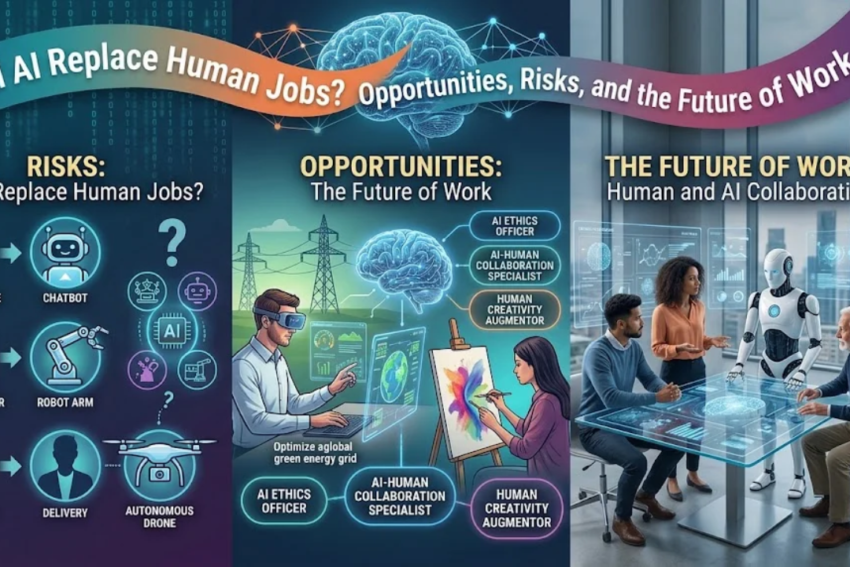
Introduction
Artificial Intelligence (AI) is transforming the modern workplace at an extraordinary pace. From chatbots and automated customer service to advanced data analysis and robotics, AI technologies are changing how businesses operate and how employees perform their daily tasks. As organizations increasingly adopt AI-powered tools, one question has become more important than ever: Will artificial intelligence replace human workers?
The answer is more complicated than a simple yes or no. AI can automate certain tasks that previously required human effort, but it can also create new opportunities, improve productivity, and help workers perform their jobs more effectively. Some professions may experience significant changes, while others will continue to depend heavily on human judgment, creativity, practical skills, and personal relationships.
In 2026, understanding the relationship between AI and employment is essential for students, job seekers, business owners, and experienced professionals. Preparing for the future requires understanding which tasks are likely to change, which skills will remain valuable, and how people can adapt to an increasingly technology-driven economy.
This article explores the potential impact of AI on employment, the risks and opportunities it creates, and the steps individuals can take to prepare for the future of work.
1. Understanding Artificial Intelligence in the Workplace
Artificial intelligence refers to computer systems designed to perform tasks associated with human intelligence, including recognizing patterns, processing language, analyzing information, and generating predictions or content.
In the workplace, AI can help employees complete tasks that require substantial time, data processing, or repetitive decision-making.
For example, an AI system can summarize a lengthy report, categorize customer inquiries, identify unusual financial transactions, or assist with analyzing medical images. Generative AI tools can also help draft emails, create presentations, and produce computer code.
Several technologies contribute to these capabilities:
- Machine learning: Helps systems identify patterns in data and make predictions.
- Natural language processing: Enables computers to interpret and generate human language.
- Computer vision: Allows systems to analyze images and videos.
- Robotics: Combines mechanical systems, sensors, and software to perform physical tasks.
- Generative AI: Produces content such as text, images, audio, and code.
These technologies are changing the workplace, but their effects vary according to the nature of a job, the reliability of the systems, and the way organizations implement them.
Importantly, automating a task is not the same as replacing an entire job. Most occupations involve several different responsibilities, and AI may be able to perform only some of them.
2. Which Jobs Are Most Vulnerable to AI Automation?
Jobs that involve repetitive, predictable, and standardized tasks may be more exposed to automation. However, exposure does not automatically mean that a job will disappear.
Data Entry and Administrative Work
Data entry often involves transferring information between systems, checking records, and organizing documents. AI-powered software can automate some of these activities, particularly when information follows predictable formats.
Administrative professionals may increasingly use AI to organize schedules, summarize documents, and prepare routine correspondence.
Nevertheless, organizations will still need people to handle exceptions, resolve communication problems, maintain records responsibly, and coordinate complex activities.
Customer Service
AI chatbots can answer common questions about products, delivery times, account procedures, and service policies.
Businesses may use these systems to provide support around the clock and reduce the volume of routine inquiries handled by human representatives.
However, complicated complaints, sensitive situations, and unusual requests often require empathy, negotiation, and careful judgment. Human customer service workers may therefore shift toward more complex responsibilities.
Basic Content Production
AI can generate initial drafts of product descriptions, marketing emails, short articles, and social media posts.
This may reduce demand for some repetitive writing tasks. At the same time, it can increase the importance of editors, subject-matter experts, and writers who provide original research, distinctive perspectives, accurate information, and strong storytelling.
Routine Financial Processing
Some accounting and financial administration tasks, such as transaction categorization, invoice processing, and basic report preparation, can be partially automated.
However, auditing, complex financial planning, regulatory interpretation, and professional accountability still require careful human oversight.
Manufacturing and Warehousing
Robots and AI-enabled machines can perform repetitive industrial tasks, inspect products, and move materials within certain environments.
Automation may change the number and type of workers required for some activities, while creating demand for technicians, engineers, maintenance specialists, and automation professionals.
The overall effect depends on costs, safety requirements, production needs, and the availability of suitable technology.
3. Jobs That May Benefit From AI Rather Than Disappear
Many occupations are likely to change through collaboration between humans and AI instead of being completely replaced.
Healthcare Professionals
Doctors, nurses, medical laboratory technologists, pharmacists, and other healthcare workers perform responsibilities that extend beyond processing information.
AI may assist with medical image analysis, documentation, research, and selected laboratory workflows. However, patient care requires clinical judgment, communication, ethical responsibility, and an understanding of individual circumstances.
For example, an AI system may flag a potentially abnormal laboratory result, but qualified laboratory professionals must interpret the finding within the appropriate testing procedures and clinical context.
Healthcare workers who understand both their professional field and the responsible use of AI may find new opportunities in laboratory informatics, clinical data analysis, quality management, and biomedical research.
Teachers and Educators
AI can generate learning materials, explain concepts, and provide practice exercises. Teachers remain important because they guide students, manage classrooms, assess development, and provide human encouragement.
Educators who integrate AI responsibly may be able to offer more flexible learning experiences while spending more time on individual student needs.
Engineers and Software Developers
AI tools can generate code, suggest solutions, identify certain errors, and assist with documentation.
However, software development also involves understanding user requirements, designing systems, ensuring security, testing reliability, and maintaining applications over time.
Engineers who use AI effectively while maintaining strong technical knowledge may become more productive.
Scientists and Researchers
AI can help researchers analyze large datasets, generate hypotheses, and identify patterns that may otherwise be difficult to detect.
Human researchers remain essential for designing experiments, evaluating evidence, interpreting results, and determining whether conclusions are scientifically justified.
AI is therefore likely to change many research workflows without eliminating the need for scientific expertise.
4. How AI Is Creating New Career Opportunities
Although automation can threaten some existing tasks, AI is also generating demand for new skills and professional roles.
AI and Machine Learning Specialists
Organizations need professionals who can develop, train, evaluate, and maintain AI systems. These roles often require programming, mathematics, statistics, and knowledge of machine learning.
Data Scientists and Analysts
AI systems depend on data, and organizations need people who can collect, clean, interpret, and communicate information accurately.
Data professionals help businesses understand trends, test hypotheses, and make informed decisions.
Cybersecurity Specialists
As organizations become more dependent on digital systems, protecting information and infrastructure becomes increasingly important.
Cybersecurity professionals investigate threats, monitor systems, and help organizations reduce the risk of data breaches and cyberattacks.
AI Governance and Safety Professionals
Businesses and governments need policies to ensure that AI systems are used responsibly.
This creates potential opportunities in AI risk assessment, compliance, privacy, auditing, system evaluation, and ethical governance.
Robotics and Automation Technicians
Factories, warehouses, and other organizations using automated equipment need people who can install, maintain, troubleshoot, and repair these systems.
These roles combine technical knowledge with practical problem-solving.
AI Integration and Implementation
Many organizations need professionals who understand both a specific industry and the AI tools that can improve its workflows.
For example, someone with experience in healthcare may help evaluate laboratory software, implement digital reporting systems, or coordinate the adoption of AI-supported processes.
This demonstrates that opportunities are not limited to people who build AI models. Professionals who know how to apply technology within their own fields may also be valuable.
5. The Impact of AI on Healthcare and Medical Laboratory Careers
Healthcare deserves particular attention because it combines rapid technological development with responsibilities involving patient safety.
AI is already being explored and deployed in selected healthcare applications, although adoption varies widely among institutions and countries.
AI in Medical Diagnostics
AI systems can analyze medical images and certain clinical datasets to identify patterns associated with disease.
In laboratory medicine, computational methods may help identify unusual results, investigate quality-control trends, and support the interpretation of complex datasets.
However, these tools must be appropriately validated before they are used for clinical purposes.
Automation of Laboratory Processes
Modern laboratories use automated instruments for activities such as sample processing, biochemical testing, hematology analysis, and immunoassays.
AI and advanced software may further automate selected steps, improve workflow management, and assist with identifying analytical problems.
This does not mean that laboratory professionals will no longer be needed. Laboratories still require qualified personnel to manage preanalytical errors, troubleshoot instruments, verify quality-control performance, maintain procedures, and ensure reliable reporting.
New Skills for Laboratory Professionals
Medical laboratory professionals can prepare for technological change by strengthening their knowledge in:
- Laboratory quality assurance and quality control.
- Laboratory information systems and digital reporting.
- Statistics and basic data analysis.
- Molecular diagnostics and biomarker research.
- Instrument troubleshooting and method validation.
- AI literacy and responsible data handling.
These skills can support career development in laboratory management, clinical research, diagnostic technology, and laboratory informatics.
The most important goal is to combine established laboratory expertise with the ability to evaluate new technologies critically.
6. Will AI Reduce Salaries or Increase Unemployment?
The economic impact of AI is difficult to predict because it depends on many factors, including the speed of adoption, the cost of automation, business demand, and government policy.
Some employers may reduce hiring for tasks that can be automated efficiently. Certain workers may face displacement, particularly when their existing skills are closely tied to repetitive activities.
Other businesses may expand because AI allows them to serve more customers, develop new products, or operate more efficiently. This can create new employment opportunities.
Pressure on Entry-Level Jobs
One concern is that AI may automate tasks traditionally assigned to junior employees, such as basic research, document preparation, and simple coding.
If organizations reduce these opportunities, new graduates may find it harder to gain the practical experience required for advanced roles.
Employers and educational institutions may need to redesign training pathways so that young professionals can develop real-world skills.
Changes in Salaries
AI may increase the productivity and earning potential of some professionals, especially those with specialized expertise.
However, it may also reduce the market value of certain routine tasks if they become easier to automate or widely available through software.
The effects will vary between industries, occupations, regions, and employers.
Economic Inequality
If the benefits of AI are concentrated among a small number of companies or highly skilled workers, income inequality could increase.
Policies supporting education, retraining, worker protections, and access to technological opportunities may help societies manage these changes more fairly.
AI’s economic effects are not predetermined. Human decisions about its development and use will play a major role in shaping employment outcomes.
7. The Human Skills That AI Cannot Easily Replace
AI systems can perform many useful tasks, but human abilities remain important in situations involving uncertainty, relationships, ethics, and complex real-world circumstances.
Critical Thinking
Professionals must determine whether information is accurate, relevant, and sufficient to support a decision.
AI can provide suggestions, but users need the ability to question assumptions, compare evidence, and recognize errors.
Emotional Intelligence
Understanding emotions, building trust, resolving conflicts, and responding sensitively to others are essential in healthcare, education, management, and customer relations.
AI may help with communication, but human relationships often require genuine social understanding and accountability.
Creativity and Original Thinking
AI can generate many ideas and combinations of existing patterns. Human creativity also involves personal experience, cultural understanding, judgment, and the ability to recognize problems worth solving.
Creative professionals who use AI as a tool while contributing original ideas may gain an advantage.
Adaptability
Technology changes rapidly. Workers who can learn new systems, adjust to unfamiliar responsibilities, and respond to changing circumstances are better prepared for uncertainty.
Ethical Judgment
High-stakes decisions often involve competing values, individual rights, and consequences that cannot be reduced to a simple calculation.
Human responsibility remains essential when determining how AI should be used and when its recommendations should be rejected.
8. How Workers Can Prepare for an AI-Driven Future
Preparing for AI does not necessarily mean changing careers or learning advanced programming. The most appropriate approach depends on a person’s profession, goals, and existing skills.
Step 1: Learn AI Fundamentals
Understand what AI can do, how it works at a basic level, and where it commonly makes mistakes.
Learn to distinguish between generating an answer, predicting an outcome, and establishing that a claim is scientifically true.
Step 2: Explore Tools Relevant to Your Job
A healthcare worker might explore AI-assisted research and data analysis. A teacher might investigate educational tools. An accountant might study automated reporting systems.
Focus on applications that solve real problems in your field rather than learning every new tool.
Step 3: Strengthen Your Professional Expertise
AI tools are most useful when users understand the subject they are working with.
A laboratory technologist who understands analytical methods and quality control is better positioned to evaluate AI-generated laboratory advice than someone without that background.
Similarly, an experienced accountant can recognize financial inconsistencies that a general-purpose AI assistant might overlook.
Step 4: Improve Digital and Analytical Skills
Learn to work with spreadsheets, digital documentation, data visualization, and relevant professional software.
Basic statistical understanding and the ability to interpret data can be useful across many occupations.
Step 5: Build a Portfolio of Practical Work
Demonstrate your skills through projects, training certificates, documented improvements, or examples of responsible AI-assisted work.
For example, a professional might create a sample workflow showing how AI can help organize non-sensitive data while retaining human verification.
Step 6: Continue Learning
Regularly review changes in your profession, identify emerging skill requirements, and pursue relevant training.
Continuous learning is more useful than assuming that any single qualification or technology will guarantee long-term job security.
9. What Employers and Governments Should Do
Preparing for AI is not solely an individual responsibility. Employers, educational institutions, and governments also influence how technological change affects workers.
Invest in Employee Training
Employers can provide training that helps employees understand AI tools, evaluate outputs, and move into higher-value responsibilities.
Retraining may help workers adapt when existing tasks become automated.
Introduce AI Responsibly
Organizations should assess whether an AI system is reliable, secure, fair, and appropriate for its intended purpose.
Employees should understand when AI can be used, when human approval is required, and who remains accountable for final decisions.
Improve Education and Vocational Training
Schools, universities, and technical institutions can incorporate digital literacy, data skills, critical thinking, and responsible AI use into their programs.
Practical training should help students apply knowledge to real problems rather than rely entirely on theoretical instruction.
Support Displaced Workers
Workers who lose employment because of automation may need access to retraining, career counseling, financial assistance, and employment services.
Effective support can help individuals transition into new roles and reduce the social costs of technological change.
10. What Will the Future of Work Look Like?
The future workplace will likely involve a combination of human expertise, AI-powered software, and physical automation.
Some tasks will become faster and less expensive. Certain jobs may shrink, while others evolve or emerge. Entirely new occupations may develop as businesses discover applications that are difficult to anticipate today.
AI assistants may help professionals research information, draft documents, analyze data, and coordinate routine activities. Robots may perform more physical tasks in suitable industrial environments. Healthcare and scientific research may benefit from better tools for analyzing complex information.
However, the pace of change will not be uniform. Some sectors will adopt AI quickly, while others will move more slowly because of regulation, cost, infrastructure, safety requirements, or the complexity of human interaction.
The future of work is therefore unlikely to be a simple contest between humans and machines. A more realistic possibility is that many jobs will be redesigned around collaboration between people and increasingly capable technologies.
Workers who combine professional knowledge, digital skills, sound judgment, and adaptability may be better positioned to benefit from this transformation.
Conclusion
Will AI replace human jobs? The most accurate answer is that AI will automate some tasks, transform many occupations, and create opportunities for new types of work. The extent of these changes will vary across industries, countries, and individual careers.
Repetitive and predictable tasks are often more suitable for automation, while roles involving complex judgment, human relationships, practical problem-solving, and accountability may continue to require substantial human involvement.
At the same time, no profession should assume that its current methods will remain unchanged. Healthcare workers, teachers, engineers, business professionals, and other employees can benefit from learning how AI tools affect their industries.
The best preparation is to develop a combination of professional expertise, AI literacy, critical thinking, communication, and continuous learning.
Artificial intelligence should not be viewed only as a threat to employment. Used responsibly, it can help people become more productive, explore new opportunities, and solve problems that were previously difficult or expensive to address.
Ultimately, the future of work will depend not only on what AI can do, but also on the choices people and organizations make about how to use it. Those who prepare thoughtfully for change will be better equipped to navigate the opportunities and challenges ahead.