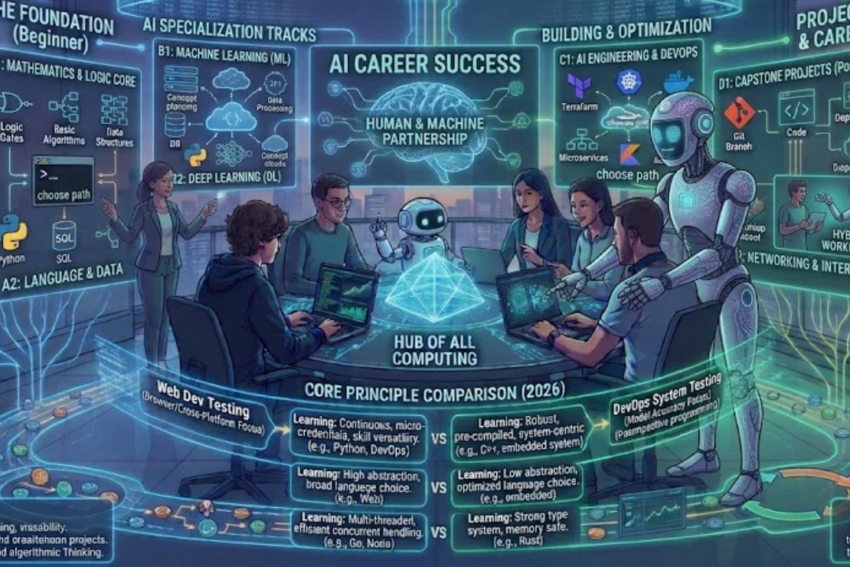
Meta Title: How to Learn Artificial Intelligence in 2026: Beginner’s Guide
Meta Description: Learn how to get started with artificial intelligence in 2026. Follow this beginner roadmap covering Python, mathematics, machine learning, AI tools, projects, and career opportunities.
Focus Keyword: How to Learn Artificial Intelligence
Secondary Keywords: learn AI for beginners, artificial intelligence roadmap, machine learning for beginners, AI programming with Python, AI projects for beginners, artificial intelligence courses, AI career roadmap
Introduction
Artificial intelligence (AI) is transforming the way people work, study, communicate, and solve problems. From chatbots and recommendation systems to medical image analysis and self-driving technologies, AI is becoming an important part of modern life.
As organizations continue to explore AI-powered solutions, more people are interested in learning how these systems work and how they can build their own applications.
However, getting started with artificial intelligence can feel confusing. There are many concepts to understand, programming languages to choose from, tools to explore, and online courses competing for your attention.
The good news is that you do not need to learn everything at once. With a structured roadmap, beginners can develop their knowledge step by step, starting with basic concepts and progressing toward practical projects.
This guide explains how to learn artificial intelligence in 2026, even if you have no previous experience in AI. You will discover the essential skills, programming languages, learning resources, project ideas, and career paths that can help you get started.
What Is Artificial Intelligence?
Artificial intelligence is a field of computer science focused on creating systems that perform tasks commonly associated with human intelligence.
These tasks can include recognizing images, understanding language, identifying patterns, making predictions, solving problems, and generating content.
AI systems use different techniques depending on the problem they are designed to solve. Some follow predefined rules, while others learn patterns from data through machine learning.
Examples of artificial intelligence include:
- Chatbots that answer questions and assist with writing.
- Recommendation systems that suggest videos, products, or music.
- Fraud detection systems that identify suspicious transactions.
- Speech recognition systems that convert spoken words into text.
- Medical AI applications that help analyze images and other clinical information.
- Translation tools that convert text between languages.
- AI-powered coding assistants that suggest and explain code.
AI is a broad field, so beginners should first understand the main branches before choosing a specialization.
Step 1: Understand the Different Types of AI
Before learning programming or advanced mathematics, become familiar with the major areas of artificial intelligence.
1. Machine Learning
Machine learning is a branch of AI in which algorithms learn patterns from data to make predictions or decisions without requiring every rule to be programmed manually.
For example, a machine learning model can learn from historical sales data to estimate future demand.
Common applications include spam detection, recommendation systems, forecasting, and fraud detection.
2. Deep Learning
Deep learning is a subset of machine learning that uses neural networks with multiple layers to learn complex patterns.
It is widely used in image recognition, speech processing, natural language processing, and many modern generative AI systems.
Deep learning can require substantial computing resources, depending on the model and task.
3. Natural Language Processing
Natural language processing (NLP) focuses on helping computers process, analyze, and generate human language.
Applications include translation, sentiment analysis, text classification, summarization, and conversational assistants.
4. Computer Vision
Computer vision enables computers to analyze and interpret visual information, such as images and videos.
It is used in manufacturing inspection, image classification, object detection, medical imaging research, and automated quality control.
5. Generative AI
Generative AI produces new content, such as text, images, audio, video, and computer code.
Large language models are one important category of generative AI. These models can generate responses based on patterns learned during training, but they can also produce incorrect information.
Beginner tip: Start with basic machine learning concepts and experiment with existing AI tools. Explore deep learning and specialized fields after you understand the fundamentals.
Step 2: Choose Your AI Learning Goal
Artificial intelligence offers several learning paths. Choosing one initial goal helps you avoid wasting time on unrelated technologies.
AI Tool User
If your main interest is using AI to improve productivity, you can begin with AI assistants, research tools, writing applications, image generators, and automation platforms.
Learn how to write clear instructions, verify generated information, protect private data, and evaluate output quality.
You can gain practical AI skills without immediately learning advanced programming.
AI Application Developer
If you want to build applications that use existing AI models, learn programming fundamentals, APIs, data handling, and application development.
You can then create chatbots, document assistants, summarization tools, and other AI-powered applications.
Machine Learning Engineer
This path focuses on preparing data, training models, evaluating performance, and deploying machine learning systems.
It usually requires Python, statistics, machine learning algorithms, software engineering, and experience with relevant libraries.
AI Researcher
AI research focuses on developing or improving methods, models, and theories.
This path typically requires stronger mathematics, experimental methods, research skills, and often postgraduate study, depending on the role.
You do not need to decide your permanent career direction immediately. Begin with foundational knowledge and refine your goals as you gain experience.
Step 3: Learn Basic Mathematics for AI
Mathematics helps explain how machine learning algorithms learn patterns and make predictions. You do not need to master advanced mathematics before writing your first program, but a solid foundation becomes increasingly important as you progress.
Focus on three main areas.
Linear Algebra
Linear algebra deals with vectors, matrices, and operations involving them.
It is useful for understanding how numerical data is represented and processed in machine learning models.
Start with:
- Vectors and matrices.
- Addition and multiplication.
- Dot products.
- Matrix dimensions.
- Basic vector operations.
Statistics and Probability
Statistics and probability help you understand data, uncertainty, and model performance.
Important concepts include:
- Mean, median, and standard deviation.
- Probability and distributions.
- Correlation and variation.
- Sampling and bias.
- Basic statistical inference.
- Evaluation metrics.
These concepts are useful when analyzing datasets and determining whether a model’s predictions are reliable.
Calculus
Calculus becomes particularly important when studying how many machine learning models are optimized.
Begin with the concepts of derivatives, gradients, and the chain rule. You can study the mathematics of gradient descent in more detail when you start learning neural networks.
Practical advice: Learn mathematics alongside programming. When you encounter a concept in a model, study the relevant mathematics rather than trying to complete every advanced mathematics topic first.
Step 4: Learn Python Programming
Python is one of the most widely used programming languages in artificial intelligence because it has a readable syntax and a large ecosystem of data science and machine learning libraries.
If you have never programmed before, begin with the basics.
Essential Python Topics
Learn:
- Variables and data types.
- Conditional statements.
- Loops.
- Functions.
- Lists, dictionaries, and sets.
- Reading and writing files.
- Error handling.
- Modules and packages.
- Basic object-oriented programming.
Practice writing small programs rather than memorizing syntax.
For example, you could write a program that reads a list of numbers and calculates their average. Later, you might adapt it to analyze information from a dataset.
Learn Important Python Libraries
After understanding basic Python, explore these libraries:
NumPy: Supports numerical calculations and array operations.
Pandas: Helps load, clean, transform, and analyze structured data.
Matplotlib: Creates charts and graphs to help you understand data.
Scikit-learn: Provides tools for traditional machine learning algorithms, preprocessing, model evaluation, and pipelines.
PyTorch or TensorFlow: Frameworks used to develop and train deep learning models.
You do not need to learn all these libraries at once. Start with NumPy and Pandas, then introduce Scikit-learn when you begin machine learning.
For early experiments, notebook environments such as Jupyter Notebook or Google Colab can make it easier to write code, display results, and explore datasets.
Step 5: Learn Data Analysis and Data Preparation
Machine learning depends on data. Even a sophisticated algorithm can perform poorly when the data is incomplete, inaccurate, biased, or unsuitable for the problem.
Before training models, learn how to inspect and prepare datasets.
Understand Data Types
Data may contain numbers, categories, dates, text, images, or other information. The type of data affects how it should be processed.
For example, a customer dataset might contain age, purchase history, location, and product categories.
Clean the Data
Real-world datasets can contain missing values, duplicates, inconsistent formats, and incorrect records.
Learn how to identify these issues and apply appropriate corrections.
Explore the Dataset
Use summary statistics and visualizations to understand the distribution of values, relationships between variables, and potential outliers.
Prepare Features
Features are the input variables used by a model. Learn about scaling numerical features, encoding categorical variables, and selecting useful inputs.
Split the Data
Machine learning projects commonly separate data into training and evaluation sets. A validation set may also be used when tuning model settings.
This helps you assess whether a model performs well on data it has not seen during training.
Be careful about data leakage, which occurs when information from outside the training process improperly influences the model.
Step 6: Study the Fundamentals of Machine Learning
Once you understand Python and basic data preparation, you can begin learning machine learning.
Machine learning models use data to learn patterns and produce predictions, classifications, recommendations, or other outputs.
Supervised Learning
Supervised learning uses labeled examples. Each training example includes input information and a known target.
Common tasks include:
- Regression: Predicting a numerical value, such as a house price.
- Classification: Assigning an item to a category, such as identifying a potentially fraudulent transaction.
Popular introductory algorithms include linear regression, logistic regression, decision trees, random forests, and support vector machines.
Unsupervised Learning
Unsupervised learning explores patterns in data without relying on labeled target values in the same way as supervised learning.
Examples include clustering similar customers or reducing the number of dimensions in a dataset.
Model Evaluation
Training a model is only one part of the process. You also need to evaluate how well it performs.
Learn about accuracy, precision, recall, F1-score, and confusion matrices for classification tasks. For regression, explore measures such as mean absolute error and mean squared error.
The best evaluation metric depends on the problem. For example, in a high-risk screening task, missing important positive cases may be more serious than generating additional false alarms.
Overfitting and Underfitting
Overfitting occurs when a model learns the training data too closely and performs poorly on new examples.
Underfitting occurs when a model fails to learn the important patterns in the data.
Learning to recognize these problems is essential for developing useful models.
Step 7: Explore Generative AI and Large Language Models
Generative AI has made it easier to build applications that work with text, images, and other forms of content.
You can explore these systems after learning basic programming, although using an existing AI tool requires less technical knowledge than developing or training a model yourself.
Learn How Large Language Models Work
Large language models (LLMs) are trained on large collections of data to learn statistical patterns in language and generate text.
Study the basic ideas behind tokens, context windows, model training, inference, and limitations such as hallucinations.
A model’s fluent response does not guarantee that its claims are accurate.
Learn Prompt Design
Prompt design involves providing clear instructions and relevant context to an AI system.
Useful practices include:
- Explaining the task clearly.
- Specifying the expected format.
- Providing relevant examples.
- Defining constraints.
- Asking the system to identify uncertainty.
- Verifying important factual claims independently.
Learn APIs and AI Applications
An API allows your program to communicate with an external service. AI APIs can be used to add text generation, summarization, classification, or other capabilities to applications.
Learn how to send requests, handle responses, manage errors, and protect API credentials.
Do not expose secret API keys in public repositories or frontend code.
Explore Retrieval-Augmented Generation
Retrieval-augmented generation (RAG) combines information retrieval with text generation. It allows an application to retrieve relevant material from a document collection or other data source and provide it as context to a language model.
RAG can be useful for document assistants and knowledge-base applications, but the quality of the results depends on retrieval accuracy, document quality, and the model’s ability to use the retrieved information correctly.
Step 8: Build Practical AI Projects
Projects help turn theoretical knowledge into practical skills. They also reveal what you understand and which topics require more practice.
Start with small projects and gradually introduce more complex features.
Beginner AI Project Ideas
1. Student Performance Prediction
Use a suitable educational dataset to explore whether selected variables can predict a numerical outcome or category.
Learn about data cleaning, feature selection, model training, and evaluation. Avoid presenting predictions as certain outcomes for individual students.
2. Spam Message Classifier
Build a model that classifies messages as spam or not spam.
This project introduces text preprocessing, feature extraction, classification, and evaluation.
3. Movie Recommendation System
Create a simple recommendation system based on user ratings or similarities between items.
You can begin with basic approaches before exploring more advanced recommendation techniques.
4. Image Classification Project
Use an established dataset to train or evaluate a model that distinguishes between image categories.
This is a useful introduction to computer vision and, later, deep learning.
5. AI-Powered Document Assistant
Build an application that answers questions about a collection of documents.
A more advanced version could retrieve relevant passages before generating an answer and provide citations to the source material.
How to Make Your Projects Professional
For every project, include:
- A clear explanation of the problem.
- The dataset source and any relevant limitations.
- The methods and tools used.
- Instructions for running the code.
- Evaluation results.
- Known limitations and potential sources of bias.
- Screenshots or a demonstration when useful.
Upload suitable projects to GitHub and write a clear README file. Never publish private or sensitive data, and check dataset licenses before redistributing datasets or derived material.
Step 9: Learn AI Tools and Development Platforms
You do not need an expensive computer or access to powerful hardware to begin learning AI.
Several tools can help you experiment with code, datasets, and models.
Google Colab
Google Colab provides a hosted notebook environment where you can write and run Python code. Depending on current availability and usage limits, it may provide access to accelerated computing resources.
It is useful for introductory data analysis and many machine learning exercises.
Jupyter Notebook
Jupyter Notebook lets you combine code, text, and visualizations in a single document. It is particularly useful for experimenting with datasets and explaining your results.
Git and GitHub
Git tracks changes in your code, while GitHub allows you to host and share repositories.
Learning version control early makes it easier to manage projects and collaborate with others.
Hugging Face
Hugging Face offers tools, libraries, and model repositories that can help you explore machine learning and natural language processing.
Review each model’s documentation, license, resource requirements, and intended use before integrating it into a project.
Cloud Platforms
Cloud services can provide access to computing resources for training, deploying, or operating AI applications.
Start with free or low-cost options where available. Check usage limits and pricing carefully to avoid unexpected bills.
Step 10: Follow a Six-Month AI Learning Roadmap
The following schedule is a flexible starting point for learners who can study consistently. Your progress will depend on your programming experience, available time, and chosen specialization.
| Month | Learning focus | Practical outcome |
|---|---|---|
| Month 1 | Python programming fundamentals | Write small programs and solve coding exercises |
| Month 2 | Mathematics and data analysis | Analyze datasets using Pandas and visualizations |
| Month 3 | Machine learning fundamentals | Train and evaluate introductory models |
| Month 4 | Model improvement and projects | Complete a classification or regression project |
| Month 5 | Deep learning or generative AI | Build a small project using a relevant framework or API |
| Month 6 | Portfolio and career preparation | Document projects, review fundamentals, and explore opportunities |
Do not treat this timeline as a guarantee of professional readiness. Six months may be enough to build a useful foundation, but advanced AI engineering and research usually require more extensive study and practice.
If you have limited time, extend the roadmap rather than rushing through essential concepts.
Step 11: Find Reliable AI Learning Resources
Choosing reliable learning resources can save time and reduce confusion.
Look for materials that combine explanations with exercises and practical assignments.
Useful starting points include:
- Python documentation and beginner tutorials: Learn programming syntax and standard-library fundamentals.
- Kaggle Learn: Explore introductory lessons in Python, Pandas, data visualization, and machine learning.
- Google Machine Learning Crash Course: Study introductory machine learning concepts and practical exercises.
- Scikit-learn documentation: Learn about traditional machine learning algorithms, data preprocessing, and model evaluation.
- PyTorch tutorials: Explore neural networks and deep learning workflows.
- Hugging Face documentation and course materials: Study language models and modern machine learning tools.
You can find these resources through their official websites. Course offerings, platform features, and pricing may change, so check the current terms before enrolling.
Avoid collecting dozens of courses without finishing them. Choose one primary resource, complete the exercises, and use additional material when you need another explanation.
Step 12: Understand AI Ethics, Privacy, and Limitations
Technical knowledge alone is not enough to build responsible AI systems.
AI models can make inaccurate predictions, reflect biases in their training data, and perform differently across groups or real-world conditions.
Important topics include:
Privacy: Protect personal information and follow applicable data-protection requirements.
Bias and fairness: Investigate whether data or model behavior disadvantages particular groups.
Transparency: Explain the purpose and limitations of a model in language that users can understand.
Security: Protect applications against unauthorized access, malicious inputs, and data leakage.
Reliability: Evaluate model performance under realistic conditions rather than relying only on impressive demonstrations.
Human oversight: Keep qualified people involved in consequential decisions, especially in healthcare, employment, finance, and other high-impact areas.
For example, an AI system used to analyze medical data should be evaluated carefully and should not replace appropriate clinical judgment merely because it produces a confident answer.
Step 13: Explore AI Career Opportunities
Artificial intelligence skills can support several career paths. The requirements differ significantly between roles, so review job descriptions before choosing a learning specialization.
Machine Learning Engineer
Develops, tests, and deploys machine learning models. Common skills include Python, data preparation, model evaluation, software engineering, and machine learning frameworks.
Data Scientist
Analyzes data to identify patterns, answer business questions, and develop predictive models. Statistics, data visualization, programming, and communication are important skills.
AI Application Developer
Builds applications that integrate existing AI models or APIs into useful products. Skills may include backend development, API integration, application security, testing, and deployment.
NLP Engineer
Works on language-related systems such as text classification, information extraction, and language model applications.
Computer Vision Engineer
Develops systems that analyze images or video. This role may involve image processing, deep learning, and model deployment.
AI Researcher
Investigates new algorithms, architectures, and methods. Many research roles require advanced mathematical knowledge and may prefer or require postgraduate qualifications.
AI Product or Automation Specialist
Identifies opportunities to apply AI to business workflows, evaluates tools, and helps integrate automation into existing processes.
A strong portfolio can help demonstrate your abilities, particularly for early-career opportunities. Formal qualifications, relevant work experience, and domain expertise may also be important depending on the role.
Common Mistakes Beginners Should Avoid
Trying to Learn Everything at Once
AI includes programming, statistics, machine learning, deep learning, computer vision, language models, and many other subjects.
Trying to master every branch simultaneously can slow your progress. Follow a structured path and add specialized topics when you are ready.
Ignoring Programming Fundamentals
AI tools can generate code, but you still need to understand the code you use. Learn Python basics, data handling, debugging, and testing before relying heavily on generated solutions.
Studying Theory Without Practical Work
Reading about algorithms is useful, but implementing and evaluating small projects helps you understand their limitations.
Ignoring Data Quality
A model trained on poor-quality or unrepresentative data may produce unreliable results. Spend time inspecting and preparing data.
Evaluating Models Only on Training Data
A model that performs well on the data used to train it may fail on new examples. Use appropriate evaluation methods and avoid data leakage.
Depending Entirely on AI-Generated Answers
AI tools can assist with learning, but their explanations may be incomplete or incorrect. Verify important concepts using trusted documentation, experiments, and other reliable sources.
Ignoring Privacy and Security
Do not upload confidential datasets or credentials to tools without checking whether their use is permitted and how the data will be handled.
Frequently Asked Questions
Can I learn artificial intelligence without a programming background?
Yes. You can begin by understanding AI concepts and experimenting with existing tools. If you want to build machine learning systems or AI applications, learning Python and basic programming is a strong next step.
How long does it take to learn AI?
You can learn introductory concepts in a few weeks, but building practical skills takes longer. A structured six-month plan can provide a foundation, while professional-level engineering and research may require years of continued learning.
Is Python necessary for artificial intelligence?
Python is one of the most useful languages for AI because of its extensive libraries and learning resources. However, other languages are used in particular applications and production systems. Python is a sensible starting point for many beginners.
Do I need advanced mathematics to learn AI?
Not to begin exploring AI tools or building simple projects. However, statistics, probability, linear algebra, and calculus become increasingly important when studying machine learning algorithms and deep learning in depth.
Can I learn AI for free?
Yes. Many official tutorials, open-source libraries, documentation resources, and introductory courses are available at no cost. Some cloud platforms, advanced courses, and AI APIs may have usage fees or limits.
Can I learn AI without a powerful computer?
Yes. Many introductory exercises can run on an ordinary computer, and hosted notebook platforms can provide computing resources for selected tasks. Large-scale model training may require specialized hardware or paid cloud services.
Which AI project should a beginner build first?
A spam classifier, simple prediction model, or introductory data-analysis project is a good starting point. Choose a project with a clear objective and a manageable dataset so you can focus on understanding the process.
Is AI a good career choice in 2026?
AI skills are relevant across many industries, but opportunities vary by location, experience, and specialization. Focus on developing practical skills, understanding the underlying technology, and building projects that demonstrate your ability to solve real problems.
Conclusion
Learning artificial intelligence in 2026 does not require mastering every AI technology at once. The most effective approach is to begin with clear goals and build your knowledge step by step.
Start by understanding AI concepts, learning Python, and developing basic mathematics and data-analysis skills. Then study machine learning, explore generative AI, and build practical projects that demonstrate your progress.
Use reliable learning resources, evaluate your models carefully, and pay attention to privacy, security, and responsible AI use.
Most importantly, focus on understanding rather than simply collecting certificates or copying code. By practicing consistently and completing projects, you can develop a foundation for further study, AI application development, or a specialized career in artificial intelligence.
SEO Publishing Checklist
- Suggested URL slug:
/how-to-learn-artificial-intelligence-in-2026/ - Focus keyword: How to Learn Artificial Intelligence
- Suggested category: Artificial Intelligence
- Featured image alt text: Beginner learning artificial intelligence and machine learning on a computer in 2026
- Internal links: Link to your articles about AI tools, machine learning versus artificial intelligence, and AI career opportunities.
- External links: Include relevant official Python, Scikit-learn, PyTorch, Google Machine Learning Crash Course, and Hugging Face resources.
- Readability: Add a table of contents, keep paragraphs manageable, and use descriptive headings.
- Final review: Check all links, verify the meta description, preview the article on mobile, and ensure that all claims are accurate and up to date.