Everyday
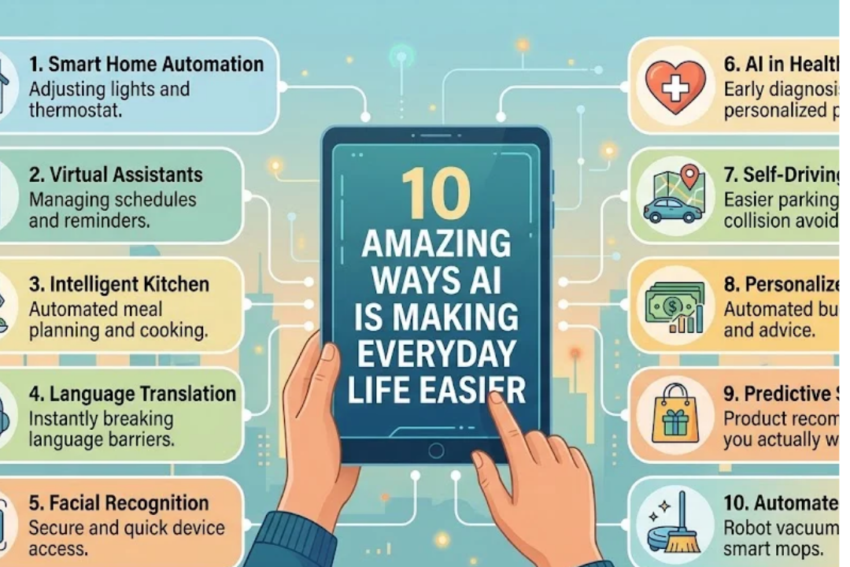
10 Amazing Ways Artificial Intelligence Is Making Everyday Life Easier
Introduction
Artificial Intelligence (AI) is rapidly becoming part of our everyday lives. From unlocking smartphones with facial recognition to receiving personalized recommendations on streaming platforms, AI technologies are changing how people communicate, work, study, shop, and manage their daily activities. What once seemed like a futuristic concept is now a practical tool used by millions of people around the world.
In 2026, AI is helping individuals save time, access information, automate repetitive tasks, and make better use of digital services. Students can use AI to understand difficult subjects, professionals can prepare reports more efficiently, and businesses can improve customer service. Even simple activities, such as navigating through traffic or organizing a daily schedule, can benefit from AI-powered systems.
Although artificial intelligence offers many advantages, it also presents challenges involving privacy, accuracy, security, and overdependence on technology. Understanding both its benefits and limitations can help people use it more effectively.
In this article, we explore ten amazing ways artificial intelligence is making everyday life easier and examine how these innovations may shape our future.
1. AI-Powered Personal Assistants
One of the most visible applications of artificial intelligence is the personal assistant. AI-powered assistants help users answer questions, organize tasks, create reminders, and access information through text or voice commands.
Tools such as ChatGPT and other digital assistants can help users draft emails, summarize documents, generate ideas, and plan activities.
For example, a busy professional can ask an AI assistant to prepare a daily schedule, organize meeting notes, or create a checklist for an upcoming project. A student can request a simplified explanation of a difficult scientific concept.
Voice assistants also make technology more accessible to people who find typing inconvenient. Users can speak commands to compatible devices to set alarms, check information, or control smart-home equipment.
The biggest advantage of these assistants is convenience. Rather than completing every small task manually, users can delegate suitable activities to AI tools.
However, users should review important outputs and avoid sharing sensitive information with services that are not approved for confidential data.
2. Smarter Healthcare and Medical Support
Healthcare is one of the most important fields in which AI can improve people’s lives. Medical professionals must analyze large amounts of information, identify potential diseases, monitor patients, and coordinate treatment.
AI can support these activities by identifying patterns in medical data and assisting with selected clinical and administrative tasks.
Early Detection and Medical Imaging
Certain AI systems can analyze medical images, such as X-rays, CT scans, and mammograms, to identify patterns associated with disease. In validated applications, these systems can help clinicians identify suspicious findings and prioritize cases requiring further examination.
AI may also help healthcare organizations manage appointments, summarize clinical documentation, and organize patient information.
Personalized Healthcare
Machine learning can help researchers study how genetic characteristics, medical histories, and other factors relate to disease and treatment outcomes.
These methods may contribute to precision medicine, in which treatment decisions are tailored to individual patients using relevant clinical evidence.
Laboratory Medicine
AI can also support clinical laboratory operations. It may help identify unusual quality-control patterns, analyze large datasets, and assist research into diagnostic biomarkers.
For example, researchers can use machine learning to investigate patterns in molecular data that may be associated with particular diseases.
Nevertheless, AI is not a substitute for qualified healthcare professionals. Medical decisions must be based on appropriate clinical evidence, validated tools, and professional judgment.
3. Personalized Learning and Education
Artificial intelligence is making education more flexible by helping students learn according to their individual needs.
Traditional classrooms often teach students at a similar pace, even though some learners need additional explanations while others are ready for more advanced material. AI-powered educational tools can help address these differences.
Learning at Your Own Pace
An AI learning assistant can explain complicated subjects using simpler language, provide examples, and generate practice questions.
For instance, a student studying chemistry can request a step-by-step explanation of chemical bonding. If the first explanation is unclear, the student can ask for an analogy or another example.
This interactive process allows learners to explore topics without feeling embarrassed about asking basic questions.
Support for Teachers
Teachers can use AI tools to create quizzes, prepare lesson plans, generate discussion questions, and adapt learning materials to different levels.
These applications may reduce administrative workload and allow educators to spend more time supporting students.
Language Learning
AI-powered language tools can help learners practice vocabulary, grammar, pronunciation, and conversation. They can also provide translations and explanations of unfamiliar expressions.
However, AI-generated educational content should be checked for accuracy. Students should use these tools to develop understanding rather than simply copy answers or avoid independent learning.
4. Navigation and Traffic Management
Getting from one place to another can be difficult, especially in busy cities where traffic conditions change throughout the day.
AI-powered navigation systems analyze information such as road conditions, historical traffic patterns, and reported incidents to estimate journey times and recommend routes.
Applications such as Google Maps use data-driven techniques to help users navigate unfamiliar locations and find alternative routes when delays occur.
Predicting Traffic
AI can help estimate when traffic congestion is likely to develop. This information can assist drivers in planning journeys and avoiding certain delays.
Improving Public Transportation
Transportation authorities can use data analysis to study passenger demand, plan services, and identify areas where transport capacity may need improvement.
Supporting Road Safety
Driver-assistance systems can use AI-related technologies to identify lane markings, detect nearby objects, and warn drivers about potential hazards.
These systems can improve convenience and support safer driving when used correctly. However, drivers must remain attentive and follow road safety regulations.
5. Smarter Shopping and Personalized Recommendations
Online shopping has become more convenient partly because of AI-powered recommendation systems.
When users browse an online store, the platform may analyze product information, search activity, and previous interactions to suggest items that match their interests.
For example, someone searching for running shoes may receive recommendations for sportswear, fitness accessories, or similar footwear.
Finding Relevant Products
AI can help online retailers organize large product catalogs and improve search results. Some systems can interpret natural-language requests, allowing customers to describe what they need rather than rely entirely on exact product names.
Customer Service
AI chatbots can answer common questions about product specifications, delivery procedures, and return policies. More complicated requests may be transferred to human representatives.
Potential Drawbacks
Personalized recommendations can save time, but they may also encourage unnecessary purchases or limit exposure to alternatives.
Retailers may use customer data to personalize advertisements, making privacy and transparency important considerations.
Consumers should compare products carefully, check seller reliability, and make purchasing decisions based on their actual needs rather than recommendations alone.
6. AI in Smart Homes
Smart-home technology allows people to control compatible household devices through mobile applications, voice commands, or automated settings.
AI can make these systems more responsive by analyzing patterns and adjusting certain functions according to user preferences.
Intelligent Temperature Control
Some smart thermostats use occupancy information, temperature measurements, and historical patterns to adjust heating or cooling schedules.
These adjustments may improve comfort and reduce unnecessary energy consumption, depending on the home and the device.
Smart Lighting
Compatible lighting systems can automatically change brightness or switch off when rooms are unoccupied. Users may also create schedules for different times of day.
Home Security
AI-enabled security cameras can identify movement and, in supported systems, distinguish between certain types of activity. This can help reduce unnecessary notifications.
However, no security system is perfect. Devices should be updated regularly, protected with strong passwords, and configured with appropriate privacy settings.
7. Faster and More Convenient Communication
Artificial intelligence has transformed how people communicate across languages, devices, and geographical boundaries.
AI-powered tools can assist with translation, speech recognition, transcription, grammar correction, and message drafting.
Breaking Language Barriers
Translation systems allow people to understand written content in other languages and communicate with speakers from different linguistic backgrounds.
Although machine translation has improved considerably, idioms, cultural context, and specialized terminology can still create problems.
Speech-to-Text Technology
Speech recognition can convert spoken words into written text. This is useful for preparing meeting notes, transcribing interviews, and creating written records.
It can also improve accessibility for people who have difficulty typing.
Writing Assistance
AI writing tools can help users improve grammar, clarify sentences, adjust tone, and organize messages.
For example, a job applicant can use AI to improve the clarity of a professional email, while a business owner can prepare a first draft of a customer announcement.
Users should check the final text to ensure it accurately represents their intentions and sounds appropriate for the intended audience.
8. AI in Banking and Personal Finance
Financial institutions use artificial intelligence and machine learning for various activities, including fraud detection, transaction monitoring, customer support, and risk analysis.
Some of these applications operate behind the scenes, helping organizations identify suspicious patterns in large volumes of financial transactions.
Detecting Fraud
AI systems can identify transactions that differ from a customer’s usual activity or match patterns associated with known forms of fraud.
When suspicious activity is detected, a bank may request additional verification or temporarily restrict a transaction, depending on its procedures.
These systems can help identify risks, but they can also produce false alarms. Customers should contact their financial institution through official channels when a transaction is questioned.
Budgeting and Spending Analysis
Some financial applications categorize transactions and summarize spending patterns. These features can help users understand where their money goes and identify opportunities to save.
Customer Support
AI assistants can answer routine banking questions and help customers navigate certain services.
However, financial decisions involving investments, loans, or major purchases require careful evaluation. Users should not rely blindly on AI-generated recommendations or share banking passwords and security codes with chatbots.
9. Entertainment and Content Creation
Artificial intelligence is changing how people discover entertainment and create digital content.
Streaming platforms can recommend films, television programs, music, and other material based on user activity and preferences.
These recommendation systems help users find content among enormous libraries of available options.
Music and Video Recommendations
AI can identify patterns in listening or viewing behavior to suggest content that users may enjoy.
Recommendations can be convenient, although they may repeatedly present similar material instead of encouraging exploration of new interests.
Creating Digital Content
Generative AI tools can assist with writing, illustrations, video concepts, music experiments, and graphic design.
A small business owner can brainstorm advertising ideas, while a content creator can use AI to outline a video or generate initial visual concepts.
These tools can reduce the effort needed to begin creative projects, but the final result may require substantial human editing.
Creators should also respect copyright, licensing conditions, privacy, and the rights of people whose likenesses or work may be involved.
10. Improving Workplace Productivity
AI is helping people complete many routine workplace tasks more efficiently.
Modern offices generate large amounts of information through emails, reports, meetings, spreadsheets, and project-management systems. AI tools can assist with organizing and processing this information.
Document Summarization
AI can summarize lengthy documents and highlight key points, allowing employees to review information more quickly.
The summary should still be checked against the original document, especially when important details or qualifications could be missed.
Data Analysis
Some AI tools can help users examine datasets, identify patterns, explain statistical results, and prepare visualizations.
This can be useful for professionals who need to understand data but do not have extensive programming experience.
Meeting Assistance
AI-enabled meeting tools may generate transcripts, identify action items, and prepare summaries, subject to the features and permissions available.
This can help teams keep track of decisions and follow-up tasks.
Reducing Repetitive Work
AI can assist with drafting standard responses, organizing records, and preparing initial versions of routine reports.
However, employees remain responsible for verifying results, protecting confidential information, and ensuring that their work meets professional standards.
The Challenges of Using AI in Everyday Life
Although AI offers many benefits, its increasing presence raises important concerns.
Privacy: AI systems may process personal information, location data, photographs, and other sensitive material. Users should understand how their information is handled and avoid sharing confidential data unnecessarily.
Accuracy: AI can generate incorrect information or misunderstand a request. Important claims should be verified using reliable sources.
Bias: AI systems may reproduce unfair patterns found in their training data, potentially affecting recommendations or decisions.
Security: AI can be misused to create convincing scams, impersonation attempts, and misleading content. Users should verify unusual requests for money or personal information.
Overdependence: Relying on AI for every decision may weaken independent thinking. People should continue developing their own knowledge, judgment, and problem-solving skills.
Addressing these challenges requires responsible technology development, clear policies, user education, and appropriate human oversight.
How to Use AI More Effectively
You do not need to be a technology expert to benefit from AI. A few practical habits can help you get better results.
- Be specific: Clearly explain what you want the AI tool to do and provide relevant context.
- Check important information: Verify medical, financial, scientific, and professional claims before acting on them.
- Protect your privacy: Avoid sharing sensitive information with tools that are not approved for that purpose.
- Use AI as an assistant: Combine its suggestions with your own expertise and judgment.
- Keep learning: Explore new features and understand their limitations as technology develops.
These habits can help people enjoy the benefits of AI while reducing avoidable risks.
Conclusion
Artificial intelligence is making everyday life easier in many ways. It helps people communicate, learn, navigate cities, shop online, manage household devices, access financial services, create content, and complete workplace tasks.
In healthcare, AI can support selected medical and research activities. In education, it can provide additional explanations and personalized practice. In business, it can reduce repetitive work and help people organize information more efficiently.
However, AI is not infallible. Privacy concerns, incorrect information, bias, and excessive dependence remain important challenges that must be addressed.
The key to benefiting from AI is to use it thoughtfully. When people combine the speed and convenience of artificial intelligence with human creativity, critical thinking, and responsibility, they can make technology a valuable part of everyday life.
As AI continues to evolve, its greatest contribution may not be replacing human effort altogether, but helping people spend less time on repetitive activities and more time on the work, relationships, and goals that matter most.Introduction
Artificial Intelligence (AI) is rapidly becoming part of our everyday lives. From unlocking smartphones with facial recognition to receiving personalized recommendations on streaming platforms, AI technologies are changing how people communicate, work, study, shop, and manage their daily activities. What once seemed like a futuristic concept is now a practical tool used by millions of people around the world.
In 2026, AI is helping individuals save time, access information, automate repetitive tasks, and make better use of digital services. Students can use AI to understand difficult subjects, professionals can prepare reports more efficiently, and businesses can improve customer service. Even simple activities, such as navigating through traffic or organizing a daily schedule, can benefit from AI-powered systems.
Although artificial intelligence offers many advantages, it also presents challenges involving privacy, accuracy, security, and overdependence on technology. Understanding both its benefits and limitations can help people use it more effectively.
In this article, we explore ten amazing ways artificial intelligence is making everyday life easier and examine how these innovations may shape our future.
1. AI-Powered Personal Assistants
One of the most visible applications of artificial intelligence is the personal assistant. AI-powered assistants help users answer questions, organize tasks, create reminders, and access information through text or voice commands.
Tools such as ChatGPT and other digital assistants can help users draft emails, summarize documents, generate ideas, and plan activities.
For example, a busy professional can ask an AI assistant to prepare a daily schedule, organize meeting notes, or create a checklist for an upcoming project. A student can request a simplified explanation of a difficult scientific concept.
Voice assistants also make technology more accessible to people who find typing inconvenient. Users can speak commands to compatible devices to set alarms, check information, or control smart-home equipment.
The biggest advantage of these assistants is convenience. Rather than completing every small task manually, users can delegate suitable activities to AI tools.
However, users should review important outputs and avoid sharing sensitive information with services that are not approved for confidential data.
2. Smarter Healthcare and Medical Support
Healthcare is one of the most important fields in which AI can improve people’s lives. Medical professionals must analyze large amounts of information, identify potential diseases, monitor patients, and coordinate treatment.
AI can support these activities by identifying patterns in medical data and assisting with selected clinical and administrative tasks.
Early Detection and Medical Imaging
Certain AI systems can analyze medical images, such as X-rays, CT scans, and mammograms, to identify patterns associated with disease. In validated applications, these systems can help clinicians identify suspicious findings and prioritize cases requiring further examination.
AI may also help healthcare organizations manage appointments, summarize clinical documentation, and organize patient information.
Personalized Healthcare
Machine learning can help researchers study how genetic characteristics, medical histories, and other factors relate to disease and treatment outcomes.
These methods may contribute to precision medicine, in which treatment decisions are tailored to individual patients using relevant clinical evidence.
Laboratory Medicine
AI can also support clinical laboratory operations. It may help identify unusual quality-control patterns, analyze large datasets, and assist research into diagnostic biomarkers.
For example, researchers can use machine learning to investigate patterns in molecular data that may be associated with particular diseases.
Nevertheless, AI is not a substitute for qualified healthcare professionals. Medical decisions must be based on appropriate clinical evidence, validated tools, and professional judgment.
3. Personalized Learning and Education
Artificial intelligence is making education more flexible by helping students learn according to their individual needs.
Traditional classrooms often teach students at a similar pace, even though some learners need additional explanations while others are ready for more advanced material. AI-powered educational tools can help address these differences.
Learning at Your Own Pace
An AI learning assistant can explain complicated subjects using simpler language, provide examples, and generate practice questions.
For instance, a student studying chemistry can request a step-by-step explanation of chemical bonding. If the first explanation is unclear, the student can ask for an analogy or another example.
This interactive process allows learners to explore topics without feeling embarrassed about asking basic questions.
Support for Teachers
Teachers can use AI tools to create quizzes, prepare lesson plans, generate discussion questions, and adapt learning materials to different levels.
These applications may reduce administrative workload and allow educators to spend more time supporting students.
Language Learning
AI-powered language tools can help learners practice vocabulary, grammar, pronunciation, and conversation. They can also provide translations and explanations of unfamiliar expressions.
However, AI-generated educational content should be checked for accuracy. Students should use these tools to develop understanding rather than simply copy answers or avoid independent learning.
4. Navigation and Traffic Management
Getting from one place to another can be difficult, especially in busy cities where traffic conditions change throughout the day.
AI-powered navigation systems analyze information such as road conditions, historical traffic patterns, and reported incidents to estimate journey times and recommend routes.
Applications such as Google Maps use data-driven techniques to help users navigate unfamiliar locations and find alternative routes when delays occur.
Predicting Traffic
AI can help estimate when traffic congestion is likely to develop. This information can assist drivers in planning journeys and avoiding certain delays.
Improving Public Transportation
Transportation authorities can use data analysis to study passenger demand, plan services, and identify areas where transport capacity may need improvement.
Supporting Road Safety
Driver-assistance systems can use AI-related technologies to identify lane markings, detect nearby objects, and warn drivers about potential hazards.
These systems can improve convenience and support safer driving when used correctly. However, drivers must remain attentive and follow road safety regulations.
5. Smarter Shopping and Personalized Recommendations
Online shopping has become more convenient partly because of AI-powered recommendation systems.
When users browse an online store, the platform may analyze product information, search activity, and previous interactions to suggest items that match their interests.
For example, someone searching for running shoes may receive recommendations for sportswear, fitness accessories, or similar footwear.
Finding Relevant Products
AI can help online retailers organize large product catalogs and improve search results. Some systems can interpret natural-language requests, allowing customers to describe what they need rather than rely entirely on exact product names.
Customer Service
AI chatbots can answer common questions about product specifications, delivery procedures, and return policies. More complicated requests may be transferred to human representatives.
Potential Drawbacks
Personalized recommendations can save time, but they may also encourage unnecessary purchases or limit exposure to alternatives.
Retailers may use customer data to personalize advertisements, making privacy and transparency important considerations.
Consumers should compare products carefully, check seller reliability, and make purchasing decisions based on their actual needs rather than recommendations alone.
6. AI in Smart Homes
Smart-home technology allows people to control compatible household devices through mobile applications, voice commands, or automated settings.
AI can make these systems more responsive by analyzing patterns and adjusting certain functions according to user preferences.
Intelligent Temperature Control
Some smart thermostats use occupancy information, temperature measurements, and historical patterns to adjust heating or cooling schedules.
These adjustments may improve comfort and reduce unnecessary energy consumption, depending on the home and the device.
Smart Lighting
Compatible lighting systems can automatically change brightness or switch off when rooms are unoccupied. Users may also create schedules for different times of day.
Home Security
AI-enabled security cameras can identify movement and, in supported systems, distinguish between certain types of activity. This can help reduce unnecessary notifications.
However, no security system is perfect. Devices should be updated regularly, protected with strong passwords, and configured with appropriate privacy settings.
7. Faster and More Convenient Communication
Artificial intelligence has transformed how people communicate across languages, devices, and geographical boundaries.
AI-powered tools can assist with translation, speech recognition, transcription, grammar correction, and message drafting.
Breaking Language Barriers
Translation systems allow people to understand written content in other languages and communicate with speakers from different linguistic backgrounds.
Although machine translation has improved considerably, idioms, cultural context, and specialized terminology can still create problems.
Speech-to-Text Technology
Speech recognition can convert spoken words into written text. This is useful for preparing meeting notes, transcribing interviews, and creating written records.
It can also improve accessibility for people who have difficulty typing.
Writing Assistance
AI writing tools can help users improve grammar, clarify sentences, adjust tone, and organize messages.
For example, a job applicant can use AI to improve the clarity of a professional email, while a business owner can prepare a first draft of a customer announcement.
Users should check the final text to ensure it accurately represents their intentions and sounds appropriate for the intended audience.
8. AI in Banking and Personal Finance
Financial institutions use artificial intelligence and machine learning for various activities, including fraud detection, transaction monitoring, customer support, and risk analysis.
Some of these applications operate behind the scenes, helping organizations identify suspicious patterns in large volumes of financial transactions.
Detecting Fraud
AI systems can identify transactions that differ from a customer’s usual activity or match patterns associated with known forms of fraud.
When suspicious activity is detected, a bank may request additional verification or temporarily restrict a transaction, depending on its procedures.
These systems can help identify risks, but they can also produce false alarms. Customers should contact their financial institution through official channels when a transaction is questioned.
Budgeting and Spending Analysis
Some financial applications categorize transactions and summarize spending patterns. These features can help users understand where their money goes and identify opportunities to save.
Customer Support
AI assistants can answer routine banking questions and help customers navigate certain services.
However, financial decisions involving investments, loans, or major purchases require careful evaluation. Users should not rely blindly on AI-generated recommendations or share banking passwords and security codes with chatbots.
9. Entertainment and Content Creation
Artificial intelligence is changing how people discover entertainment and create digital content.
Streaming platforms can recommend films, television programs, music, and other material based on user activity and preferences.
These recommendation systems help users find content among enormous libraries of available options.
Music and Video Recommendations
AI can identify patterns in listening or viewing behavior to suggest content that users may enjoy.
Recommendations can be convenient, although they may repeatedly present similar material instead of encouraging exploration of new interests.
Creating Digital Content
Generative AI tools can assist with writing, illustrations, video concepts, music experiments, and graphic design.
A small business owner can brainstorm advertising ideas, while a content creator can use AI to outline a video or generate initial visual concepts.
These tools can reduce the effort needed to begin creative projects, but the final result may require substantial human editing.
Creators should also respect copyright, licensing conditions, privacy, and the rights of people whose likenesses or work may be involved.
10. Improving Workplace Productivity
AI is helping people complete many routine workplace tasks more efficiently.
Modern offices generate large amounts of information through emails, reports, meetings, spreadsheets, and project-management systems. AI tools can assist with organizing and processing this information.
Document Summarization
AI can summarize lengthy documents and highlight key points, allowing employees to review information more quickly.
The summary should still be checked against the original document, especially when important details or qualifications could be missed.
Data Analysis
Some AI tools can help users examine datasets, identify patterns, explain statistical results, and prepare visualizations.
This can be useful for professionals who need to understand data but do not have extensive programming experience.
Meeting Assistance
AI-enabled meeting tools may generate transcripts, identify action items, and prepare summaries, subject to the features and permissions available.
This can help teams keep track of decisions and follow-up tasks.
Reducing Repetitive Work
AI can assist with drafting standard responses, organizing records, and preparing initial versions of routine reports.
However, employees remain responsible for verifying results, protecting confidential information, and ensuring that their work meets professional standards.
The Challenges of Using AI in Everyday Life
Although AI offers many benefits, its increasing presence raises important concerns.
Privacy: AI systems may process personal information, location data, photographs, and other sensitive material. Users should understand how their information is handled and avoid sharing confidential data unnecessarily.
Accuracy: AI can generate incorrect information or misunderstand a request. Important claims should be verified using reliable sources.
Bias: AI systems may reproduce unfair patterns found in their training data, potentially affecting recommendations or decisions.
Security: AI can be misused to create convincing scams, impersonation attempts, and misleading content. Users should verify unusual requests for money or personal information.
Overdependence: Relying on AI for every decision may weaken independent thinking. People should continue developing their own knowledge, judgment, and problem-solving skills.
Addressing these challenges requires responsible technology development, clear policies, user education, and appropriate human oversight.
How to Use AI More Effectively
You do not need to be a technology expert to benefit from AI. A few practical habits can help you get better results.
- Be specific: Clearly explain what you want the AI tool to do and provide relevant context.
- Check important information: Verify medical, financial, scientific, and professional claims before acting on them.
- Protect your privacy: Avoid sharing sensitive information with tools that are not approved for that purpose.
- Use AI as an assistant: Combine its suggestions with your own expertise and judgment.
- Keep learning: Explore new features and understand their limitations as technology develops.
These habits can help people enjoy the benefits of AI while reducing avoidable risks.
Conclusion
Artificial intelligence is making everyday life easier in many ways. It helps people communicate, learn, navigate cities, shop online, manage household devices, access financial services, create content, and complete workplace tasks.
In healthcare, AI can support selected medical and research activities. In education, it can provide additional explanations and personalized practice. In business, it can reduce repetitive work and help people organize information more efficiently.
However, AI is not infallible. Privacy concerns, incorrect information, bias, and excessive dependence remain important challenges that must be addressed.
The key to benefiting from AI is to use it thoughtfully. When people combine the speed and convenience of artificial intelligence with human creativity, critical thinking, and responsibility, they can make technology a valuable part of everyday life.
As AI continues to evolve, its greatest contribution may not be replacing human effort altogether, but helping people spend less time on repetitive activities and more time on the work, relationships, and goals that matter most.